


Tracking the Globe and More: Thailand – The Spirit House
Tracking the Globe and More: Thailand – The Spirit House
15 October 2026
BANGKOK, Thailand
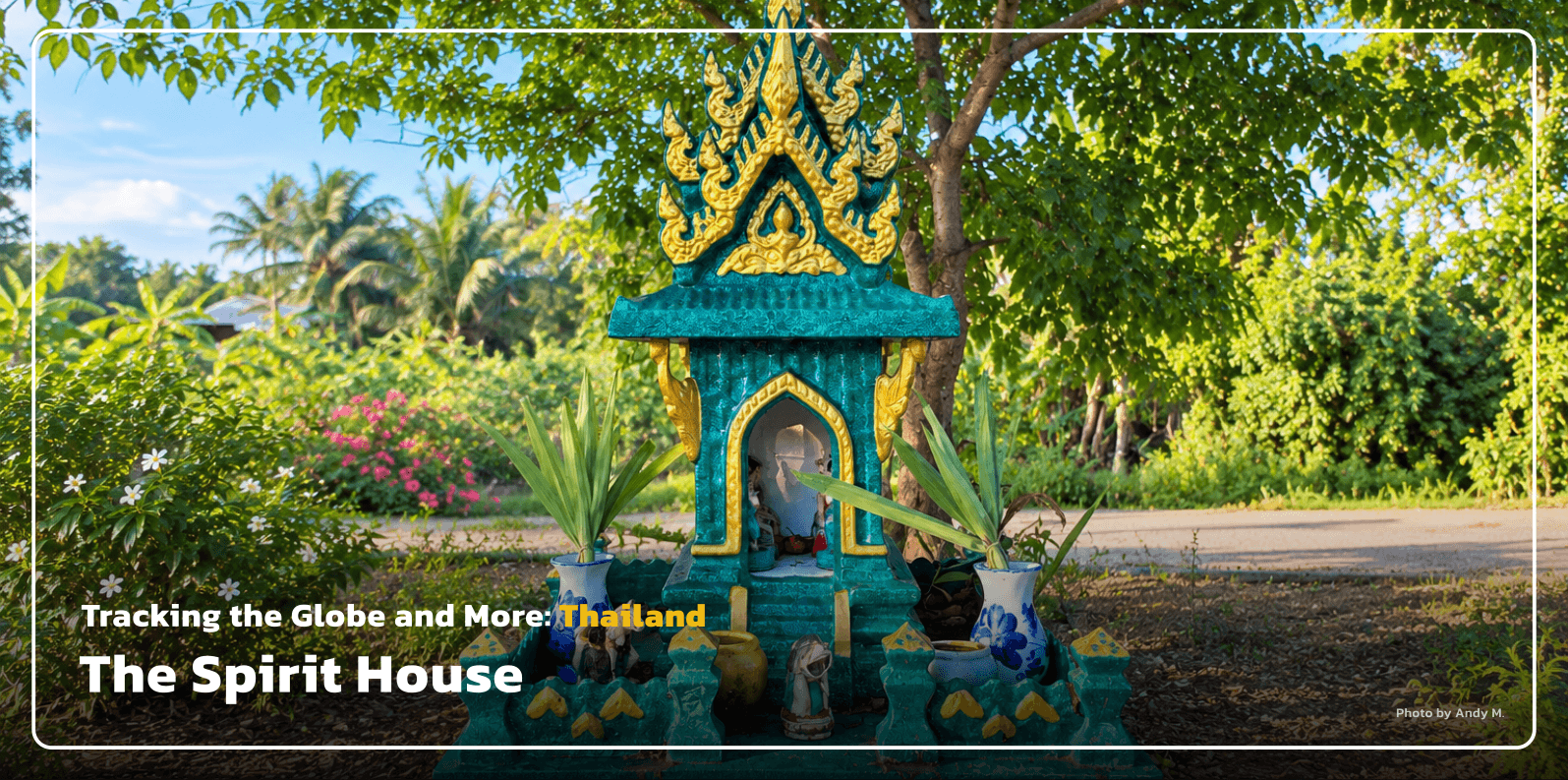
In Thailand, you can find tiny houses in the most unexpected places. But did you know that they are not actually meant for people?
These houses are believed to be residences for divine beings, spirits, and even ghosts!
Even though the majority of Thailand’s population is Buddhist (The Government Public Relations Department, n.d.), animistic beliefs and the practice of spirit worship existed long before Buddhism came to Thailand (Poshakrishna, 2023, p.32). Traditional animistic beliefs emphasize a strong connection with nature and the environment. Spirits and ghosts (Phi in Thai) may be associated with trees, mountains, rivers, streets, and even houses (Poshakrishna, 2023, p.32).
For many Thai people, these spirits can influence everyday life. Unhappy spirits may bring misfortune or bad luck, while benevolent spirits may bring good fortune, happiness, or prosperity.
To show respect and keep the spirits appeased, people may set up a Spirit House and leave offerings such as incense, flowers, food, and drinks.

A Spirit House or San, is a small house, temple or castle-like structure. The size, height, material, number of pillars, and level of decoration can vary depending on the type and status of the spirit believed to reside there (เค.ที.ศาลพระภูมิ, 2025). It can be dedicated to local spirits, house spirits (Phi Ruan or Jao Ti), or land guardian spirits known as Phra Phum associated with a particular place (ThailandCorner, 2025).
The Spirit House is an important reflection of how animism and Buddhism coexist in Thai tradition. The practice of respecting the invisible forces is a subconscious behavior, which can be found throughout Thailand.
Follow Yannix as we continue our 4th decade of Tracking the Globe, and more…!
_____
Sources
- Poshakrishna, P. (2023). Animism in Thai Society. MCU Haripunchai Review, 7(4), 284–294. Retrieved from https://so04.tci-thaijo.org/index.php/JMHR/article/view/aA-019
- ThailandCorner. (2025, November 19). Spirit Houses & Animism.
https://thailandcorner.com/living/culture/spirit-houses - The Government Public Relations Department. (n.d.). Religions in Thailand. Sawasdee Thailand. Retrieved September 15, 2026, from https://thailand.go.th/page/religion
- เค.ที.ศาลพระภูมิ. (2025, December 18). ศาลพระภูมิ ศาลตายาย ศาลพระพรหมแตกต่างกันอย่างไร. KT ศาลพระภูมิ. https://www.kt-spirithouse.com/knowledge/what-is-different-about-all-shrine-in-thai-belief/

15 October 2026
BANGKOK, Thailand
In Thailand, you can find tiny houses in the most unexpected places. But did you know that they are not actually meant for people?
These houses are believed to be residences for divine beings, spirits, and even ghosts!
Even though the majority of Thailand’s population is Buddhist (The Government Public Relations Department, n.d.), animistic beliefs and the practice of spirit worship existed long before Buddhism came to Thailand (Poshakrishna, 2023, p.32). Traditional animistic beliefs emphasize a strong connection with nature and the environment. Spirits and ghosts (Phi in Thai) may be associated with trees, mountains, rivers, streets, and even houses (Poshakrishna, 2023, p.32).
For many Thai people, these spirits can influence everyday life. Unhappy spirits may bring misfortune or bad luck, while benevolent spirits may bring good fortune, happiness, or prosperity.
To show respect and keep the spirits appeased, people may set up a Spirit House and leave offerings such as incense, flowers, food, and drinks.
A Spirit House or San, is a small house, temple or castle-like structure. The size, height, material, number of pillars, and level of decoration can vary depending on the type and status of the spirit believed to reside there (เค.ที.ศาลพระภูมิ, 2025). It can be dedicated to local spirits, house spirits (Phi Ruan or Jao Ti), or land guardian spirits known as Phra Phum associated with a particular place (ThailandCorner, 2025).
The Spirit House is an important reflection of how animism and Buddhism coexist in Thai tradition. The practice of respecting the invisible forces is a subconscious behavior, which can be found throughout Thailand.
Follow Yannix as we continue our 4th decade of Tracking the Globe, and more…!
_____
Sources
- Poshakrishna, P. (2023). Animism in Thai Society. MCU Haripunchai Review, 7(4), 284–294. Retrieved from https://so04.tci-thaijo.org/index.php/JMHR/article/view/aA-019
- ThailandCorner. (2025, November 19). Spirit Houses & Animism.
https://thailandcorner.com/living/culture/spirit-houses - The Government Public Relations Department. (n.d.). Religions in Thailand. Sawasdee Thailand. Retrieved September 15, 2026, from https://thailand.go.th/page/religion
- เค.ที.ศาลพระภูมิ. (2025, December 18). ศาลพระภูมิ ศาลตายาย ศาลพระพรหมแตกต่างกันอย่างไร. KT ศาลพระภูมิ. https://www.kt-spirithouse.com/knowledge/what-is-different-about-all-shrine-in-thai-belief/
See other related posts
See other related posts